Memory, oblivion, and legacy
The KillerMemory, oblivion, and legacy are not secure inheritances in the dramatic material but contested practices, shaped by love, political authority, and the material limits of preservation. Berenger the First seeks to turn his life into an eternal public record; Queen Marguerite and The Doctor are ready to manufacture that record, while Queen Marie fears that personal forgetting will erase her. Against both ambitions, the plays insist that memory is vulnerable: it can fade in an instant, be edited into legend, or survive only as a page in a library that may burn or crumble.
Making a Legacy
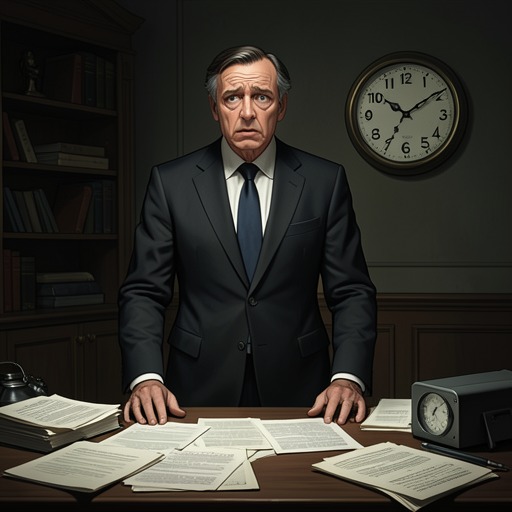
When Berenger the First cries out in pain, Queen Marguerite dismisses the ordinary quality of his response. She had expected terror to produce ringing phrases, she says, and therefore puts The Doctor in charge of the chronicles. They will attribute other people’s fine words to the king and invent new ones if necessary. The Doctor accepts the task of watching over the legend. Legacy begins here not as an impartial account of a life, but as a deliberate editorial project: a ruler’s record can be improved, supplied with borrowed eloquence, and managed by those who survive him.
Berenger the First’s own vision of remembrance is more expansive still. He imagines history books devoted to his life, kingdom, and exploits; other books burned, other statues destroyed, and his likeness installed in public squares, ministries, town halls, and hospitals. He wants vehicles named after him and his name used to teach children to read. His demands extend from civic display to religious imagery: his likeness on icons and crosses, Mass said for him, and even the Host made into his image. Rivers, windows, and public institutions all become surfaces on which his identity might be inscribed. The catalogue’s growing scale makes his wish both grand and desperate: no corner of collective life should remain outside his memorial.
The Limits of Duration
Even this imagined totality cannot answer Berenger the First’s fear of being forgotten. He asks how long remembrance could last, then projects it into immense stretches of time, including twenty thousand years and two hundred and fifty-five thousand million years. Yet he concludes that there will eventually be no one left to remember anyone. The extinction of the audience defeats the fantasy of an eternal monument: memory requires living minds, and no quantity of public commemoration can guarantee their survival. His thought turns still further toward cosmic endings, treating the eventual exhaustion of the earth and the explosion of universes as outcomes that cannot be prevented by postponement. What must end, he reasons, is already finished in principle.
The other voices sharpen this collapse of temporal distance. Queen Marguerite declares, “Everything is yesterday.” Juliette observes that even the present will become the past, and The Doctor says, “All things pass into the past.” These are not promises that history will preserve what has passed; they make passing itself the governing condition. Berenger the First’s desire to be remembered forever therefore meets a world in which every present is already receding and every future audience is temporary.
The Doctor gives that vulnerability a concrete scale by imagining the king reduced to a page in a ten-thousand-page book, housed in one of a million libraries containing a million books. The page might be catalogued by subject and alphabet, but cataloguing only makes it findable for a time. Paper may turn to dust, and libraries may burn. Institutional preservation offers an orderly route back to the past, not protection from physical destruction. The grand ambition to occupy all history ends, in this image, as a small and vulnerable fragment among countless other records.
Intimate Memory and the Self
Public commemoration is not the only form of remembrance at stake. Queen Marie experiences forgetting as a threat to her existence: she believes Berenger the First is forgetting her in the present moment and says she cannot go on living if she no longer exists in his distracted heart. She describes their survival as reciprocal, each keeping the other alive through remembrance. Her plea gives memory an intimate force that the king’s monuments cannot supply. Where his imagined legacy demands recognition from nations and generations, hers depends on one person’s attention.
A passage shaped like the recollection of a dream makes that attention unstable. In the morning, the dream’s faces and events blur as the reality of day drives them away; the dreamer is left with regret but cannot recover what was there. Berenger the First then recognizes the same loss in his own experience: he remembers having belonged to a world centered on him, but cannot recover what else that world contained. The movement from a general account of waking forgetfulness to the king’s faltering recognition makes his world itself feel like something slipping out of memory.
Queen Marguerite answers by separating the king from what she calls an accumulation of bits and pieces attached to him. She compares these attachments to mistletoe on a bough and ivy on a wall, then mimes removing an invisible ball and chain, a sack, a pack, and spare army boots. Berenger the First tries to straighten as the burdens are taken away. The scene does not restore a detailed past; instead, it stages the removal of accumulated weight as a condition of release. Memory and identity are thus unsettled together: what appears to constitute the self may also weigh it down, and letting go is expressed through physical gestures rather than a recovered narrative.
History, Repetition, and the Present
A school lesson offers a public version of the same struggle over what will be remembered. The schoolmaster’s voice begins recounting representatives arriving at the palace gates and shouting for cake; a voice from the street repeatedly interrupts with the claim that there are fifty-eight delivery boys. The historical anecdote and the present refrain occupy the same sequence, but the interruption prevents the lesson from becoming a sealed, self-contained past. Public history is transmitted through education, yet what reaches the listener is also shaped by repetition and interruption.
In a separate scene, Bérenger says that the crimes in the Radiant City may have contributed to Édouard’s illness. Édouard gets up, says he is freezing, and prefers a walk outside to a blanket. The exchange sets an immediate bodily condition beside Bérenger’s attempt to interpret suffering through events. It does not resolve what can be remembered or explained; it keeps attention on a vulnerable present that cannot be replaced by a chronicle. Taken together, these scenes distinguish remembrance from mastery. Records can be composed, lessons repeated, and loved ones held in mind, but none of these acts can make memory permanent or ensure that the past will remain intact.